"Why, Sir, you find no man, at all intellectual, who is willing to leave London. No, Sir, when a man is tired of London, he is tired of life; for there is in London all that life can afford." — Samuel Johnson
Showing posts with label Iain Sinclair. Show all posts

Wednesday, 16 March 2011

City of Absence

Many films have London as their location - few actually have London as the prime subject.  Patrick Keiller's melancholic film London captures the essence of the place like no other film. Paul Scofield's hypnotic voice narrates a series of forays across London made in the company of the unseen protagonist Robinson, as they follow in the footsteps of poets, exiles and visionaries such as Montaigne, Mallarmé, Rimbaud, Verlaine and Poe and try to uncover 'the problem of London.'  Set in 1992 against a backdrop of political, economic and cultural decline, their wanderings take them from the heart of the City to the far reaches of suburbia, and portray a London which is crumbling, deeply divided and alienating but at the same time 'so exotic, so home-made.'

The film consists of a series of static shots of sometimes startling beauty and resonance, accompanied by Scofield's ironic voiceover and an elegiac soundtrack and evokes a London which has gone forever, even though the film was made a relatively short time ago in 1994.  There is a deeply melancholic and nostalgic feeling permeating the whole film, which stems from the perception of the void at the centre of modern urban life.  The narrator's voice muses "For Londoners, London is obscured, too thinly spread, too private for anyone to know, its social life invisible, its government abolished.... the true identity of London is in its absence."  Iain Sinclair describes this absence as a 'necropolis of fretful ghosts, a labyrinth of quotations: not so much the ruin of a great city as the surgical removal of its soul.' (1)

There is a quietness and stillness about the film which is mesmerising.  One of the most memorable sequences is a short scene showing a pair of young children playing in the dappled sunlight of Arnold Circus in Shoreditch, East London, the sounds of the children's cries ringing out against the intermittent distant traffic noise and rustling of pigeons' wings - an island of calm and tranquillity.

Still from London by Patrick Keiller

Arnold Circus is part of the Boundary Estate, the first example of social housing development built by the London County Council in 1897 to replace one of London's most notorious slum areas - The Old Nichol Street Rookery - and immortalised in Arthur Morrison's fictionalised account of the life of a slum child A Child of the Jago.  The rubble from the slum clearance was used to make a mound in the centre of the Circus, site of the bandstand which is still in existence.  In the film Robinson considers the estate to be 'a fragment of a golden age, a utopia.'

Little changed, the area still feels like a peaceful backwater that resonates with a sense of the past although only a stone's throw from the galleries, shops and cafes of rapidly changing Shoreditch. Walking around there recently it was relatively easy to visualise the scenes from the film and I understood what attracted Keiller to the place.....
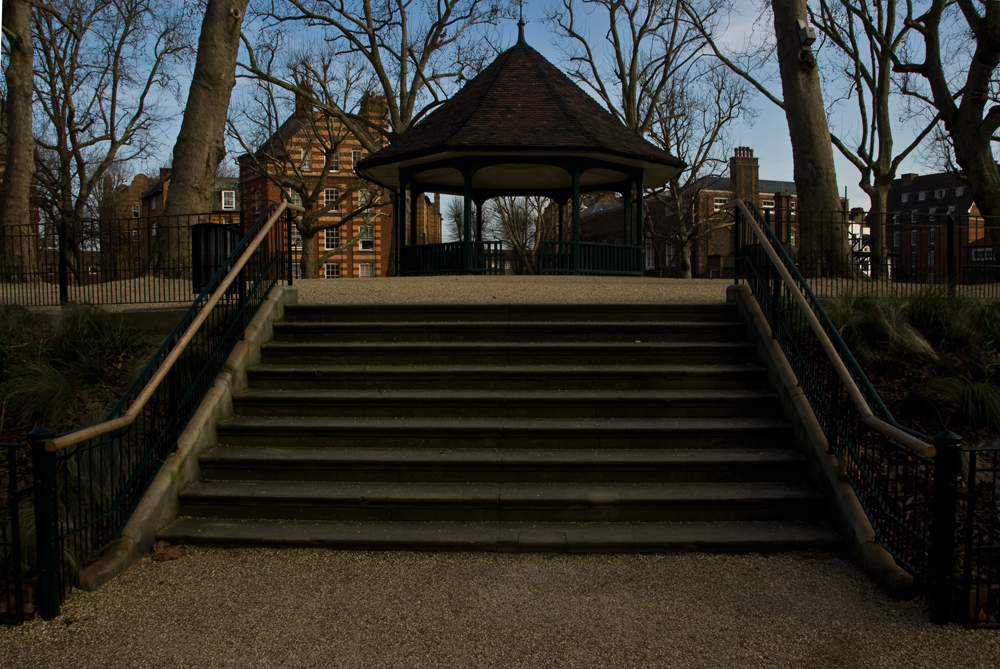


Keiller's London documents a bygone era but the concerns of the film seem particularly relevant to the current political, economic and social situation.  Possibly a case of what goes around, comes around...... 

(1) Sinclair, Iain: London: Necropolis of fretful ghosts, essay in the booklet accompanying the DVD London and Robinson in Space 

Saturday, 22 January 2011

Secret Theatre

Some films have London locations which assume a special importance - one of the most famous being Michelangelo Antonioni's 1966 film Blow Up.  The most seductive and memorable scenes occur, not in the trendy city streets of Swinging London, but in a quiet municipal park in unglamorous Charlton, south east London.  Maryon Park is another one of those rather unlikely places in London that has its own special atmosphere.  Author and psychogeographer Iain Sinclair devotes a chapter to it in his book Lights Out for the Territory. The pivotal scene of the film takes place in a secluded grass platform at the top of the park, which Sinclair suggests has a special psychic resonance -  "....that one covert strip of grass, with its sentinel trees, its wind chorus, its doorway into other worlds".

Scene from Blow Up


After rewatching the film a  little over a year ago, I was mesmerised by the sequences shot in the park, so decided to visit and see for myself.  Although the approach to the park has been much changed since the film was shot, once inside, the row of trees marking the boundary still stands exactly as before.  Just as in the film, on entering the park the noise and frenetic pace of the city are distanced.  Traffic noise is still audible, but the wind in the trees, the birdsong and the distant cries of children in a school playground have the effect of cocooning you from reality, almost transporting you to a different plane.  Sinclair describes a similar sensation:

“Coming into Maryon Park from Woolwich Road, as I did when I made my original investigation, is uncanny.  It plays directly into the film, into the very specific sound of wind in the trees...Antonioni took a lot of trouble to identify this enclosed meadow, to see it as the essence of his film.” 

The main part of the park is shaped like an amphitheatre with steep wooded sides and a rather dilapidated tennis court in the centre - the setting for the surreal mimed tennis game in the film.  To the left of the court is the flight of steps leading up to the private grassy area, the scene of the lovers' tryst where the supposed murder takes place.


Scene from Blow Up


Scene from Blow Up


Antonioni's production designer, Assheton Gorton, described this location as a "theatre box", an ancient place containing powerful energies, likening its spatial design to the work of Surrealist painter de Chirico and Antonioni himself chose it because of its "charged metaphysical atmosphere" (1)  This kind of mysticism can be traced back to late Victorian and Edwardian tales of the uncanny, popularised by the likes of Arthur Machen, and to the enigmatic cult of ley lines originally proposed by Alfred Watkins, where the effects of ancient events are superimposed upon the modern landscape leading to "a slipping of space and time".  It is in fact a place which has connections with a much older civilisation, being the site of an ancient Roman hill fort. 

I wondered whether this mysticism might just be the product of an over-active imagination, but after spending about 3 hours wandering around, I came away with the impression of a rather mournful place which did not give up its secrets easily, one where the presence of the past is almost tangible and more real than the present....