"Why, Sir, you find no man, at all intellectual, who is willing to leave London. No, Sir, when a man is tired of London, he is tired of life; for there is in London all that life can afford." — Samuel Johnson

Saturday, 2 April 2011

In Memoriam


"Greater love hath no man than this, that he lay down his life for his friends"  John 15:13

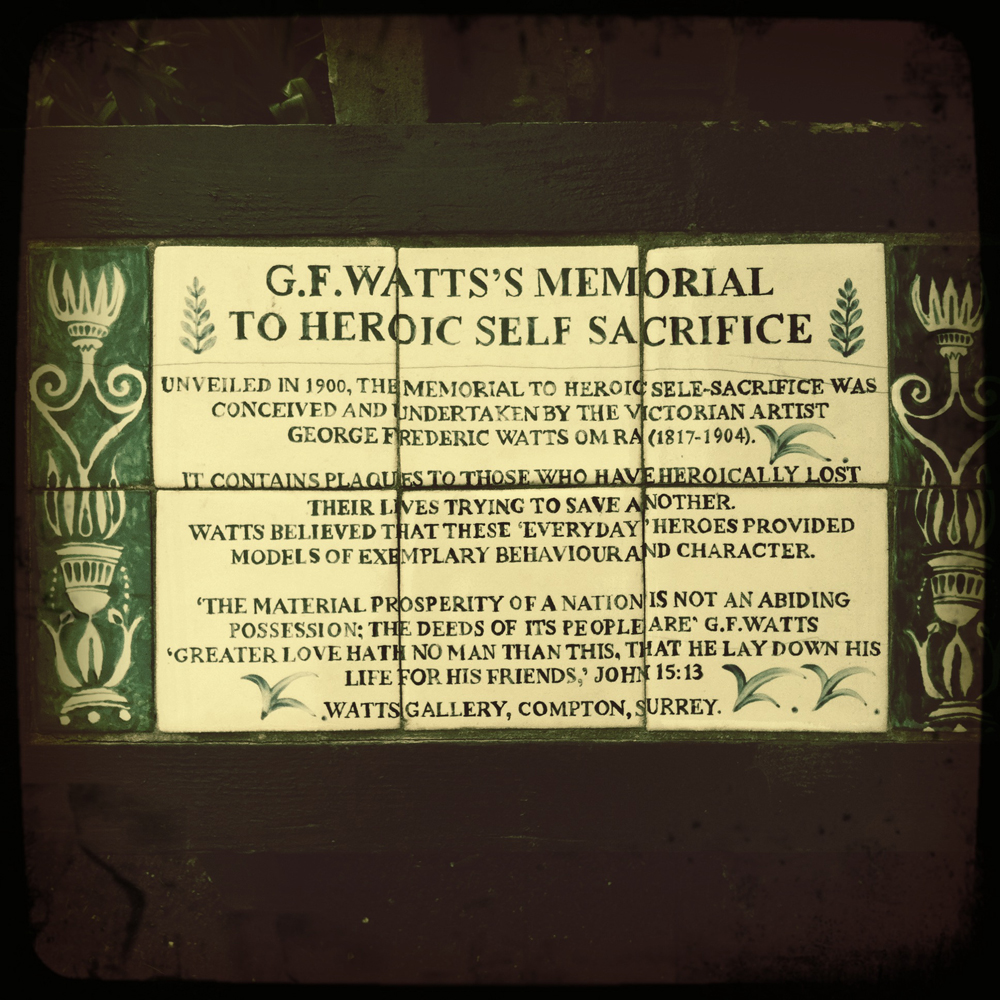
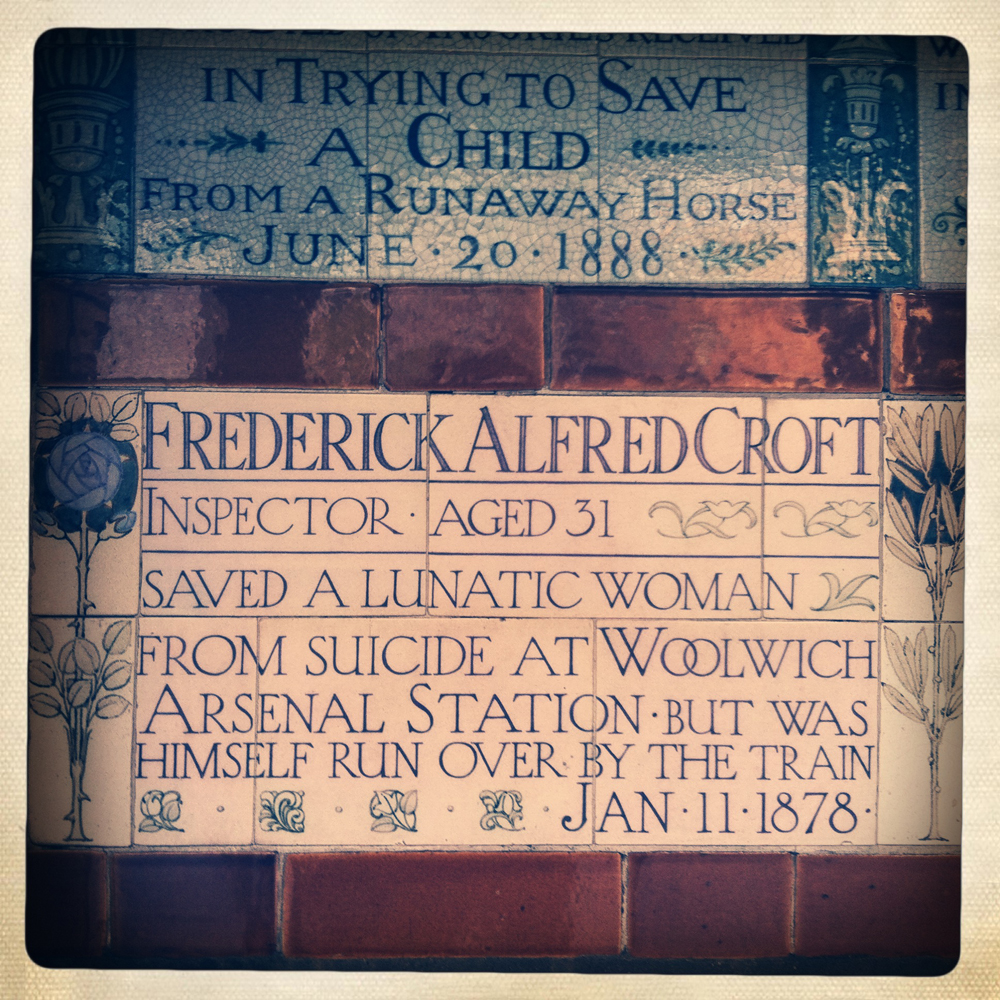
Last month I found myself by chance in Postman's Park, a little oasis of green tucked away in the heart of the city and the site of an unusual memorial to those who have died trying to save the lives of others.  The memorial was conceived by Victorian artist George Frederic Watts and consists of simply decorated ceramic tiled plaques detailing names, dates and acts of bravery. A couple of weeks later, in one of those strange instances of serendipity, I came across a moving tribute to this very memorial on a visit to artist Susan Hiller's exhibition at Tate Britain.  Entitled Monument (1980-81), it consists of a large-scale arrangement of photographs of 41 plaques - one for each year of the artist's life at the time of making, - a park bench and a cassette player and headphones.  The visitor is invited to sit down on the bench, don the headphones and listen to an audio tape of the artist's voice musing on the nature of absence, memory, death, heroism and representation.

Susan Hiller's Monument at Tate Britain

Hiller's work often deals with notions of 'cultural artefacts' which have been forgotten or overlooked.  Whilst photographing the tiles, she noticed that people sitting in the park appeared not to be aware of their existence: 
"....there were people sitting on park benches in front of them eating their lunches, who turned round over their shoulders to look, as if for the first time, at what I was photographing. And when they had seen the plaques they said things like ‘Oh! Isn’t it sad? Isn’t it dreadful?’ But what struck me was that they had sat in front of these perfectly visible objects for years and years, and the objects had been, literally, invisible." (1)   


As the viewer settles down to listen to the words on the tape they become part of the installation: "You are sitting, as I've imagined you, with your back to the 'Monument'. The 'Monument' is behind you. The 'Monument' is in your past." Each person commemorated by a plaque existed as a living person but also continues to exist as a representation - she lists their names and their two modes of existence "....Ernest Benning....in the body 22 years, as a representation 98 years, Elizabeth Boxall...in the body 17 years, as a representation 98 years..... " She quotes the words of Goethe "You can think of life after death as a second life which you enter into as a portrait or inscription and in which you remain longer than you do in your actual living life". However, she acknowledges the impossibility inherent in the act of representation:
 "An inscription, a registration, a trace; you can't represent anything in the present; when you represent it, it's already in the past.....representation is a distancing in time and space.  It's a re-generation of images and ideas. Time can't exist without memory. Memory can't exist without representations."


How long does a memory last?  The memory of a particular person dies out within a few generations, when there is nobody still alive who remembers the dead person. What remains is just a memorial - words, inscriptions, photographs - an attempt to confound the implacable nature of time and a futile gesture against the inevitable transience of all human life.  Of all the methods of memorialisation, however, the photograph must surely be the most powerful.  The photograph has a direct link with the living body of the person portrayed. According to philosopher Roland Barthes in his famed treatise on the nature of photography Camera Lucida, it does not 'restore what has been abolished....but attests to what has existed.'  He maintained that photography was a kind of resurrection: "what I see is not a memory, an imagination, a reconstitution.....but reality in a past state: at once the past and the real." (2)

As we stand and read the inscriptions on the plaques, we do not have the benefit of a photograph to remind us of the existence of these brave souls. The words do not conjure up the flesh and blood, only their final acts of bravery. When we look at these memorials the main effect they have is to remind us of our own mortality. We marvel at the self-sacrifice, but then we look at the dates, compute the lengths of their lives, and measure it against our own.  Artist Christian Boltanski, noted for his work on identity, memory, time and death, succinctly summed it up:  "What remains when life ends? Two dates and a short black line...." (3)

Perhaps then the most lasting memorial of all is the one that the artist leaves behind - their art....


(1)  Susan Hiller, exhibition catalogue, Tate Gallery Liverpool 1996
(2)  Barthes, Roland:  Camera Lucida
(3)  Boltanski, Christian: Time 

Wednesday, 16 March 2011

City of Absence

Many films have London as their location - few actually have London as the prime subject.  Patrick Keiller's melancholic film London captures the essence of the place like no other film. Paul Scofield's hypnotic voice narrates a series of forays across London made in the company of the unseen protagonist Robinson, as they follow in the footsteps of poets, exiles and visionaries such as Montaigne, Mallarmé, Rimbaud, Verlaine and Poe and try to uncover 'the problem of London.'  Set in 1992 against a backdrop of political, economic and cultural decline, their wanderings take them from the heart of the City to the far reaches of suburbia, and portray a London which is crumbling, deeply divided and alienating but at the same time 'so exotic, so home-made.'

The film consists of a series of static shots of sometimes startling beauty and resonance, accompanied by Scofield's ironic voiceover and an elegiac soundtrack and evokes a London which has gone forever, even though the film was made a relatively short time ago in 1994.  There is a deeply melancholic and nostalgic feeling permeating the whole film, which stems from the perception of the void at the centre of modern urban life.  The narrator's voice muses "For Londoners, London is obscured, too thinly spread, too private for anyone to know, its social life invisible, its government abolished.... the true identity of London is in its absence."  Iain Sinclair describes this absence as a 'necropolis of fretful ghosts, a labyrinth of quotations: not so much the ruin of a great city as the surgical removal of its soul.' (1)

There is a quietness and stillness about the film which is mesmerising.  One of the most memorable sequences is a short scene showing a pair of young children playing in the dappled sunlight of Arnold Circus in Shoreditch, East London, the sounds of the children's cries ringing out against the intermittent distant traffic noise and rustling of pigeons' wings - an island of calm and tranquillity.

Still from London by Patrick Keiller

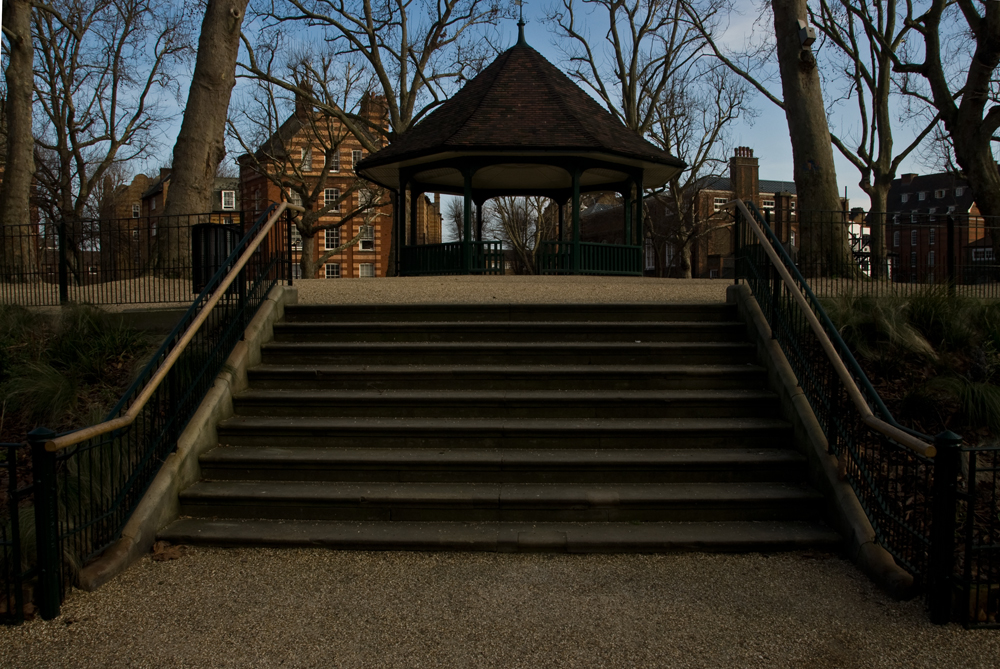
Arnold Circus is part of the Boundary Estate, the first example of social housing development built by the London County Council in 1897 to replace one of London's most notorious slum areas - The Old Nichol Street Rookery - and immortalised in Arthur Morrison's fictionalised account of the life of a slum child A Child of the Jago.  The rubble from the slum clearance was used to make a mound in the centre of the Circus, site of the bandstand which is still in existence.  In the film Robinson considers the estate to be 'a fragment of a golden age, a utopia.'

Little changed, the area still feels like a peaceful backwater that resonates with a sense of the past although only a stone's throw from the galleries, shops and cafes of rapidly changing Shoreditch. Walking around there recently it was relatively easy to visualise the scenes from the film and I understood what attracted Keiller to the place.....


Keiller's London documents a bygone era but the concerns of the film seem particularly relevant to the current political, economic and social situation.  Possibly a case of what goes around, comes around...... 

(1) Sinclair, Iain: London: Necropolis of fretful ghosts, essay in the booklet accompanying the DVD London and Robinson in Space 

Monday, 7 March 2011

Infinite City

Continuing on from my last post as I follow Janet Cardiff's mysterious tour of the Whitechapel area....

The voice on the disc guides you through the streets towards Brick Lane and the surrounding area of Spitalfields with its rich and many-layered history.  The area has witnessed waves of immigration over the centuries - Huguenots, Irish, Jews, Bangladeshis have all made their home here. As the sound of her footsteps echoes through the streets and in your brain, you realise that every step of the way you are treading in the paths of previous generations. "How can we just walk over the footsteps and not remember?" she asks, as she relates a story of a man who waited for 20 years for the woman he loved to return, all the while playing his violin in his room.

At every turn there is evidence of London's endless cycle of regeneration, the old cheek by jowl with the new. She wonders whether the construction workers are aware of their role as 'changers of the city, the men who cover up the old stories making room for new ones.'  The tapping of her footsteps on the paving stones seem to emphasise the unfathomable immensity of the city - not just in its spread but in its depth, its layers reaching back far into time and resurfacing at odd moments in an architectural detail or an obscure place name. She observes that "The city is infinite. No-one has ever found an end to the pattern of the streets. Eventually the buildings reproduce themselves - a cornice that mimics another, a door that is the same colour as hundreds of others; every possible permutation - unlimited but cyclical."


This is what Peter Ackroyd refers to when he describes London as 'echoic' - the idea of the city as constantly reinventing itself, yet retaining its basic identity: 
"It has been said that no stone ever leaves London but is reused and redeployed, adding to that great pile upon which the city rests.  The paradox here is of continual change and constant underlying identity; it is at the core of the antiquarian passion for a continually altering and expanding city which nevertheless remains an echo chamber for stray memories and unfulfilled desires." (1)
And as people pass through the labyrinth of streets, they leave traces of their presence behind them as they go....


"Keep walking past the newstand.  Dead Woman Identified." she whispers.


With my imagination fired by the tangled web of narratives and multiple layers of sounds, my perambulations end fittingly in a nearby railway station - a repository of countless unknown stories, criss-crossing briefly but rarely coinciding.  As she stands on the walkway looking down on the concourse, her voice muses "I like watching the people from here.  All of these lives heading off in different directions, one story overlapping with another....."


I follow her instructions, but as I stand there with my camera and survey the scene, I notice that I have been spotted .  I smile in a conciliatory way but three pairs of hostile eyes continue to return my gaze with such intensity, that I scuttle off and head for the tube.  It seems ironic that in these days of constant surveillance and ubiquitous digital camera footage, the mere sight of a photographer with a camera in a railway station can provoke such suspicion.

(1)  Ackroyd, Peter:  London The Biography

Monday, 28 February 2011

Babel

Walking through London's streets can sometimes feel a little like entering the Tower of Babel - you hear snatches  of conversation in a multitude of languages, jostle with people of all ages, types and nationalities against a backdrop of buildings both ancient and modern. Everywhere is a tangled mass of narratives, overlapping in space and time.


Something of this idea is evident in the work which  sound artist Janet Cardiff devised in 1999 in association with Artangel, a London based arts organisation which commissions and produces site-specific projects by contemporary artists. Entitled The Missing Voice (Case Study B) the work is a compelling audio experience involving listener participation, comprising a set of recorded instructions and enigmatic observations to be listened to on a Sony Walkman borrowed from the Whitechapel Library.  The library is no longer in the same building, but it is still possible to follow the walk 12 years later, picking up the thread from outside the building which now forms part of Whitechapel Gallery. It can be downloaded as a podcast.

Described as 'part urban guide, part detective fiction, part film noir', the listener is immediately transported on a journey through time and space as Cardiff's voice whispers conspiratorially in your ear, her observations intertwined with fevered stream of consciousness scenarios involving memories, a complicated relationship, stalking, pulp fiction, newspaper headlines, a missing woman with long red hair, murder. "I want you to walk with me.  There are some things I need to show you," her gentle yet hypnotic voice intones against the backdrop of ambient noise from the street - conversations, traffic noise, footsteps, sirens, music, dogs barking.  As you walk and listen you see the outside world through her eyes, experiencing unexpected new perspectives on your surroundings, the past and the present intermingling until it is difficult to differentiate between what you are hearing on the tape and the sounds from the real world outside your headphones. Passing strangers briefly become your companion.   "Someone is following you" a man's voice suddenly breathes in your ear..... 


"Have you ever had the urge to disappear," she asks, "to escape from your own life, even just for a little while? Like walking out of one room and into a different one."  Being in the city on your own offers an opportunity to assume different roles, to blend in with the crowd, to observe unseen. "I like not talking to anybody all day, except when I pay for a book or a cup of tea or something." she says, "It's like you're invisible." There are echoes here of Virginia Woolf's Street Haunting where she writes of 'shedding the self our friends know us by' as she slips out of her house and into the streets. She also shares Woolf's delight in dispassionately observing everyone she comes across, noting little details and idiosyncrasies and then moving on. But there is a darker undercurrent of fear and paranoia running through Cardiff's monologue which had me looking over my shoulder on numerous occasions. "There's a man in a black suit walking behind you" the man's voice interjects again suddenly....  

To be continued....

Monday, 21 February 2011

Colourless Serenity


The dome of St. Paul's Cathedral might not dominate the London skyline as it did in the past, having to compete with the likes of the Gherkin, the rapidly growing Shard and sundry other modern edifices, but it is still one of London's most iconic buildings.  It has been the inspiration for many writers, painters and photographers over the centuries. Sir Christopher Wren's elegant design replaced the old Gothic cathedral that stood on the site after it was destroyed in the Great Fire of London of 1666. Diarist John Evelyn described how the flames engulfed the cathedral:
"the stones of St. Paul's flew like Grenades, the melting lead running down the streets in a stream, and the very pavements glowing with fiery redness, so as no horse nor man was able to tread on them."  
Four centuries later the scene was repeated in the Blitz when the Luftwaffe firebombed the City of London in 1940.  One of the most famous and symbolic pictures of the time is the photograph showing St.Paul's rising proudly like a phoenix from the ashes above the devastation inflicted by the bombing raid....

St. Paul's Cathedral in the Blitz, Herbert Mason

But for me the most evocative image of St Paul's is Bill Brandt's photograph of the cathedral in the moonlight, part of his series documenting London during the blackout, which combines a kind of forlornness coupled with majesty....

St. Paul's Cathedral in Moonlight, Bill Brandt

Canaletto depicted the newly built St. Paul's with the river in the foreground in his own inimitable style, making it look like a scene from Venice....

The River Thames with St. Paul's Cathedral on Lord Mayor's Day, Canaletto c.1747-8, 

Its dome has dominated the skyline for four centuries, a fact noted by Virginia Woolf in The London Scene, a collection of articles originally written for the magazine Good Housekeeping in the 1930s where she compares St. Paul's with Westminster Abbey. 
"It is a commonplace, but we cannot help repeating it, that St. Paul's dominates London. It swells like a great grey bubble from a distance; it looms over us, huge and menacing, as we approach. But suddenly St. Paul's vanishes. And behind St. Paul's, beneath St. Paul's round St. Paul's when we cannot see St. Paul's, how London has shrunk!" 
 It is indeed difficult to get the measure of St. Paul's unless you view it from across the river, its very immensity seeming to undermine all attempts to grasp it.


She compares the faceless, jostling crowds in the streets with the monumental calm and bulk of St. Paul's:
"..behold how we jostle and skip and circumvent each other in the street, how sharply we cut corners, how nimbly we skip beneath motor cars.  The mere process of keeping alive needs all our energy.  We have no time we were about to say, to think about life or death either, when suddenly we run against the enormous walls of St. Paul's.  Here it is again, looming over us, mountainous, immense, greyer, colder, quieter than before."


Novelist Monica Ali follows in Woolf's footsteps in a short essay After Wolf, wandering the same streets and taking in the same sights, 'catching at thoughts and impressions'. She notes Woolf's description of St. Paul's as 'august in the extreme but not in the least bit mysterious' and observes that:
"Mystery is still in short supply, though for different reasons now. Heritage Inc has snuffed what mystery remained. St.Paul's has a corporate identity, a corporate colour (red) and all the many signs are multilingual and very smartly designed. It seems, too, to have a corporate voice which speaks in warm and friendly tones, the kind of customer-centred "care" that we have come to expect. "St. Paul's audio tour. Try me!" "Thank you for visiting us. We hope that you leave the Cathedral inspired and refreshed and will return again one day." 
This is probably the price we have to pay to maintain our heritage these days - our experience of the city's great monuments seems to be sanitised and homogenised to such a degree. Woolf characterises St. Paul's splendour as residing in its 'colourless serenity' and claims that on entering the cathedral we undergo a 'pause and expansion and release from hurry and effort'.  Unfortunately on this occasion I wasn't able to share this experience as I felt disinclined to fork out £14.50 for the rather hefty entrance fee - it seems they even charge for entry into heaven these days!


Monday, 14 February 2011

Alone in the city

In literary descriptions of London, the city is usually characterised as crowded, pulsing with life, its streets teeming with a multitude of people going about their business. One of the delights of being in London is the ability to be anonymous amongst this multitude, to be able to step back from the crowd and observe.  Virginia Woolf relished the kind of solitude entailed in wandering around London, where one's identity is almost subsumed - in her essay Street Haunting she describes her pleasure in walking the city and becoming part of that "vast republican army of anonymous trampers."
(see my post A Question of Identity)

Rebecca Solnit illustrates this point well in the chapter on urban walking in her book Wanderlust where she compares it to "a sort of basking in solitude". Being alone in the country outside of any human contact is quite different to being alone in the city, where you are alone amongst strangers and she maintains that it is one of life's starkest of luxuries to be "a stranger surrounded by strangers, to walk along silently bearing one's secrets and imagining those of the people one passes".


This theme is also touched upon in a book I am currently reading London Fragments - A Literary Expedition by Rüdiger Görner - a collection of essays exploring the capital's literary landscape from the point of view of the outsider, the non-Londoner.  In a chapter about the London inhabited by European exiles, a quote from the novel 'Die Unsichtbare Wand' (The Invisible Wall) by the writer and scholar H G Adler, sums up the way in which London seems to suck in and find room for all its inhabitants:
"Let me disappear in the cosmopolitan city.  It is incalculable, confused, eerie... it has mysterious neutrality....You cannot belong to this city, yet you are in it, independent, almost free, you are little touched by it and everyone minds their own business.  I can foresee that I will never be completely lost specifically because of its forlornness."  
This forlornness is sometimes quite palpable in certain areas and seems to be the default mood of the city - a kind of melancholy which haunts the streets despite the crowds and the noise, where each one of us is alone with our thoughts yet part of the fabric of the streets.


However, things have changed since these words were written and it is probably true to say that nowadays you are never truly alone in the city.  Wherever you go, just look up and you will see the ubiquitous security camera with its all-seeing eye trained on you.  At least they can't read your thoughts......yet.